
What Hubbuy does, and where it stops
Hubbuy is a buying and forwarding service. It places orders with Chinese sellers on your behalf, receives the goods into a warehouse, photographs them, holds them, and ships the combined parcel to you.
Browse the catalogue first if you are still deciding what to order.
Two services share one account
There are two distinct things happening under one login, and confusing them is the most common way a first order goes sideways.
The first is buying on your behalf. You supply a link, the agent pays the seller, the seller ships to the agent warehouse. The second is forwarding. You buy from the seller yourself, have it sent to a warehouse address the agent gives you, and the agent only handles the parcel from arrival onwards.
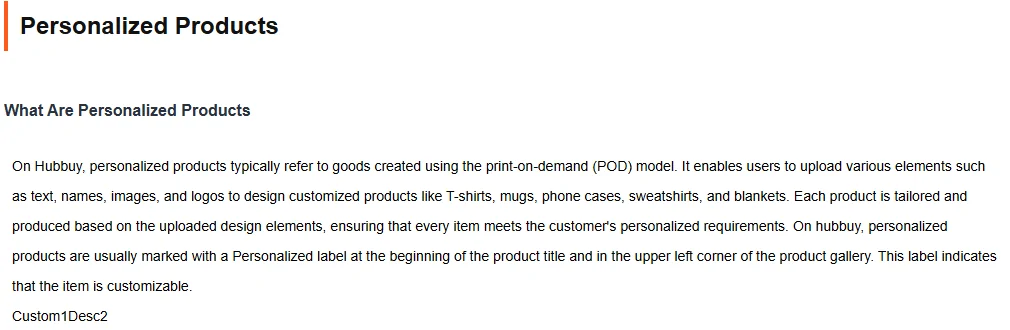
A third category sits on top of both: made-to-order goods. The official guide calls these personalised products and flags them in the listing title and in the gallery corner. They are printed or made after you order, so they are slower and, once made, considerably harder to cancel.
Historical source screenshot
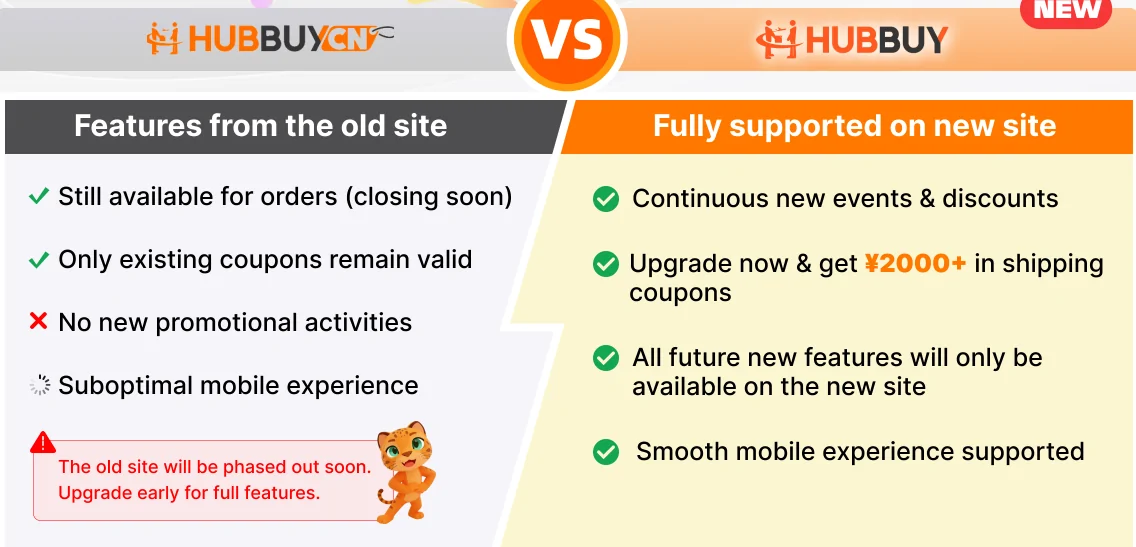
What the HubbuyCN migration notice documented
The official comparison captured on 23 September 2026 described a move from HubbuyCN to Hubbuy. Its old-site column reported that ordering remained available at that time, while new promotions had stopped. Those statements describe the captured notice, not today's service status.
That matters for a practical reason that has nothing to do with marketing. Guides, screenshots and help articles written against the old site are still circulating, and some of them show forms that no longer look the same. If a walkthrough you are following shows a different field, check the domain in its screenshots before you assume you are on the wrong page.
What actually changed, form by form, is on updates.
Historical source screenshot
Where the service stops, stated by the operator
The most useful sentence the agent has published about itself is a disclaimer. It draws the line between what the agent is responsible for and what it is not, and the line is further back than most first-time buyers assume.
Everything on the catalogue side comes from third-party sellers. The agent handles money, logistics and photographs. It does not vouch for the goods.
All products available for shopping agent service displayed on Hubbuy are from third-party shopping platforms and not directly sold by Hubbuy.
Official help centre, Disclaimer for Proxy Purchase and Shipped Goods, captured 2026-09-23. Full article: the proxy purchase disclaimer.
The advantages that are structural, not promotional
Almost every agent in this market offers the same core: they buy for you, they hold goods in a warehouse, they combine parcels, they photograph what arrives, and they ship by several carriers. None of that distinguishes one from another, and you should be suspicious of any site that presents it as a differentiator.
What is genuinely structural at Hubbuy is breadth on the buying side: automatic reading of four large Chinese platforms, plus a documented manual path for everything else, plus a forwarding path for goods you have already bought. That combination means a single account covers the three ways people usually end up needing to get something out of China.
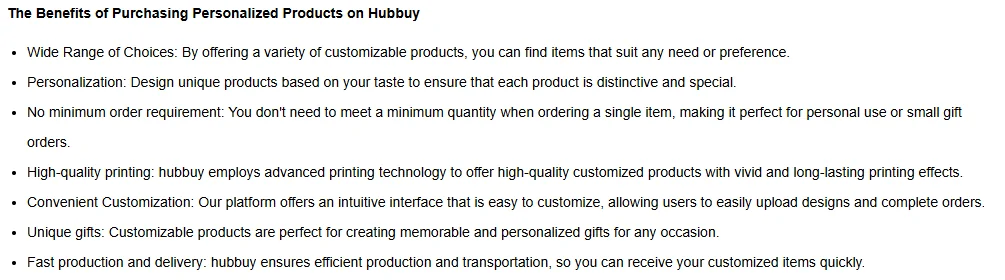
The made-to-order support is the other one. The official guide lists what it is good for, and the honest summary of that list is that it suits low volume and personalised items rather than bulk.
Put the two together and the answer to why Hubbuy rather than somebody else is about intake, not about the goods. It takes in more kinds of purchase than most, and that is a reason to pick it only if your purchases are varied. If they are not, the advantage is worth nothing to you.
Historical source screenshot
Forwarding is the half most people do not know they need
If you have already bought something and it is sitting with a Chinese seller who will not ship abroad, you do not need the buying service at all. You need an address, a tracking number and a place to consolidate.
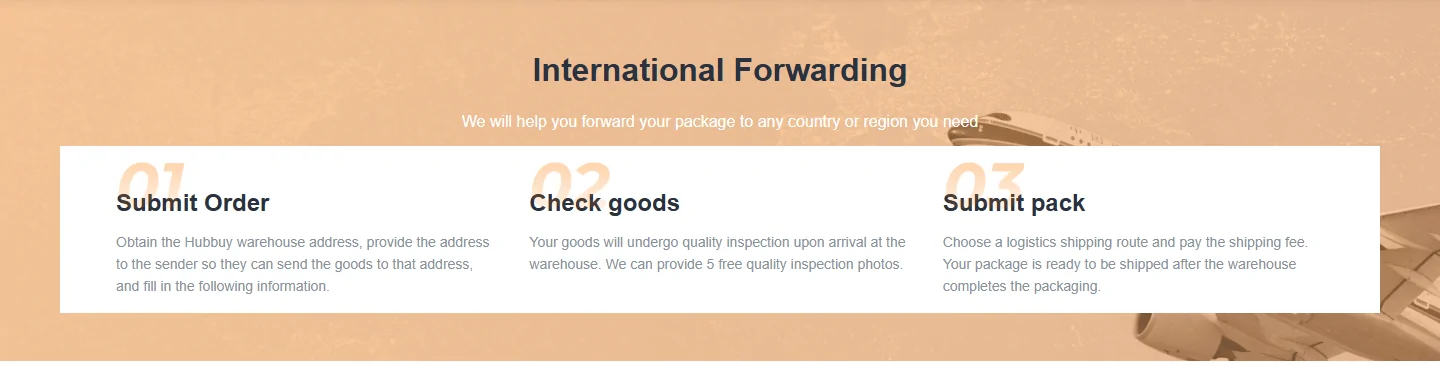
The official forwarding flow is three cards: submit the order with the warehouse address, let the goods be checked on arrival, then submit the pack for shipping. The free photographs on arrival apply here too.
This is also the path where your own accuracy matters most, because the agent never saw the purchase and has nothing to match the parcel against except what you typed. Your first order walks both paths in order.
Historical source screenshot
When you should choose a different agent
Choosing an agent is mostly a matter of knowing when a given one is the wrong answer, and a guide that cannot name such a situation is an advertisement. Here are three, and they are not edge cases.
If your seller is on a platform outside the four that are read automatically and you are ordering many different items, the manual form becomes real work and an agent that reads your platform natively will be faster. If you need component-level testing rather than an appearance check, ask for a documented inspection service and its scope before choosing an agent. And if your parcel is a single light item going somewhere with a high duty threshold, consolidation buys you nothing and paying the seller to ship direct is simpler.
What the inspection does and does not cover is set out on checks worth doing.
* Which service do you actually need
Buying, forwarding, or neither. This is the question to settle before you open an account, not after.
The warning the agent puts above its own order button
The manual order form carries a disclaimer directly above the buttons, and it is the plainest statement of the relationship anywhere on the site. It says the goods are third-party, that the agent can find affiliated sellers, consult, buy on your behalf and arrange third-party logistics, and that it cannot verify quality or authenticity.
You tick a box to confirm you have read it. Most people tick it without reading it, which is a pity, because it tells you exactly which risks stay with you: everything to do with what is inside the box. The rules that follow from that are collected on help and terms.
Historical source screenshot
